
Welcome to the May 2026 Edition of the Arista Federal Newsletter!
May is a month of meaningful celebration and remembrance. We recognize and appreciate all mothers for the tremendous impact they have on our families, communities, and future generations. As Memorial Day approaches, we also pause to honor and remember the brave men and women who made the ultimate sacrifice in service to our nation. In this edition, we continue highlighting the technologies, customer successes, and strategic initiatives helping Federal agencies and System Integrators modernize infrastructure for the future through automation, AI networking, operational simplicity, and secure, resilient architectures.
“A hero is someone who has given his or her life to something bigger than oneself.” — Joseph Campbell (1904–1987) - American writer.
In this month’s newsletter, you’ll find:
-
Arista TAC Continues to Set the Standard for Customer Success
Arista Federal Client Director Kevin Carey highlights why Arista TAC continues to stand apart and the operational value it delivers to Federal customers supporting classified, AI/HPC, data center, campus, and WAN environments.
Exceptional technology is only part of the equation; world-class customer support truly defines long-term success.
-
Arista and the Department of War: Sharing Innovation for the Mission!
Arista Systems Engineer Michael Alvarez explores how modern networking technologies support next-generation mission requirements across the Department of Defense.
As Federal agencies continue modernizing infrastructure to support AI, HPC, and advanced analytics, this article highlights why Arista is uniquely positioned to help customers accelerate innovation while reducing operational complexity.
This newsletter is for you and we welcome your feedback, ideas, and requests at fed@aristafederal.com.
Thank you for reading the Arista Federal Newsletter — your go-to source for the latest innovations, industry insights, and mission-focused networking solutions for Federal Agencies and System Integrators.
Arista Blog

Arista TAC Continues to Set the Standard for Customer Success
By Kevin Carey – Arista Federal Client Director
Arista Networks continues to demonstrate why its Technical Assistance Center (TAC) is recognized as one of the industry’s premier support organizations. In 2026, Arista TAC improved upon its already exceptional previous NPS score of 87, achieving an industry- leading Net Promoter Score (NPS) of 89, with 94% of customers reporting a strongly positive experience.
These results reflect Arista’s relentless focus on customer success, operational excellence, and technical expertise. For many customers, Arista TAC is one of the company’s strongest differentiators and a key reason why organizations choose and remain with Arista.
Unlike traditional support organizations that rely on multiple escalation tiers and scripted workflows, Arista TAC is built around a highly technical, engineering-driven support model focused on accelerating problem resolution and enhancing the “customer experience”. Customers work directly with experienced network engineers who possess deep expertise in Arista EOS and modern network architecture.
Why Arista TAC Stands Apart
Arista TAC provides:
- 24x7 global technical support
- Direct access to highly skilled network engineers
- Hardware and software troubleshooting
- EOS software support and upgrade guidance
- Configuration assistance and operational best practices
- RMA coordination and proactive operational guidance
A key differentiator is the close alignment between TAC and Arista’s EOS engineering teams, enabling faster root-cause analysis, rapid issue resolution, and tighter feedback loops between customers and development.
Operational Value for Federal Customers
For Federal organizations, where mission continuity, operational simplicity, and rapid issue resolution are critical, the value of a world-class support organization cannot be overstated.
Because Arista operates a single EOS operating system across campus, data center, WAN, and AI environments, TAC engineers develop deep platform expertise across the entire portfolio. This consistency enables:
- Faster troubleshooting and reduced escalation delays
- Shorter Mean Time to Resolution (MTTR)
- Lower operational overhead
- More accurate operational guidance
- Reduced lifecycle complexity
Arista’s software quality and architectural consistency also contribute to fewer critical issues, lower CVE exposure, and fewer emergency maintenance events. As a result, many TAC engagements are consultative and operationally focused rather than crisis driven.
A Trusted Operational Partner
Customers often view Arista TAC as an extension of their own operational teams. Beyond troubleshooting, TAC regularly assists customers with:
- Design guidance
- Automation workflows
- EOS upgrades and migrations
- Best practices and feature adoption
- Operational optimization
This partnership-oriented approach helps Federal customers confidently deploy and operate next-generation networking technologies across mission-critical, classified, AI/HPC, campus, and data center environments.
The 2026 NPS results further reinforce Arista’s commitment to delivering not only innovative technology, but also an exceptional “customer experience”.
Arista and the Department of War: Sharing Innovation for the Mission!
By Michael Alvarez - Systems Engineer, US Federal
Mission Critical
When we think of the Department of War (DoW), we think of phrases such as “mission critical”, “supporting warfighter efforts” and “saving lives”. These are the calls that invigorate and motivate the workforce within the DoW with purpose and initiative to innovate. Recently, it has been decided that the status quo of the mission was not keeping pace with our adversaries around the world and there was fear that The United States was falling behind in that initiative and innovation.
The Need for Speed
In 2024, an effort within Congress to bolster defense innovation was made by creating the House Defense Modernization Caucus. The purpose? To shift the paradigm by working to streamline and accelerate the DoW’s Authority to Operate (ATO) process, providing attractive offerings to increase the hiring speed of industry talent and increase classified space access for private sector companies to come in and innovate. Most importantly, they wanted the Department of War to lean on more modern software-centric and commercial-of-the-shelf (COTS) solutions. They wanted to leverage this in a way where the wheel could stop being re-invented and to repurpose foundational solutions across multiple environments. This would be the key to identifying challenges, streamlining innovation and reducing time and waste.
RDMA in Play
Recently, Arista Federal has seen many of its customers more commonly adopt mission based software applications leaning heavily into the use of Remote Direct Memory Access (RDMA) over Converged Ethernet (RoCE) protocol. This architectural concept allows software applications to bypass a host CPU’s TCP/IP stack to achieve faster data transfers. In essence, faster data analysis and processing, faster early warning systems, faster response in the battle space. Think back to those phrases mentioned earlier.
RDMA…Cutting Edge?
No, not really. RDMA has existed as far back as 2003 with the inception of the RDMA Consortium. It was developed to approach more efficient ways to move data between endpoints across a network with high throughput and low latency. However, to really achieve this goal, the right network technology needs to be able to support RDMA.
The Birth of RDMA over Converged Ethernet (RoCEv1)
In 2010, the Infiniband Trade Association released an initial version of RoCEv1 to support RDMA applications across an ethernet environment. This effectively enabled RDMA to work over Ethernet, operating at the Ethernet link layer (Layer 2). There were many benefits to the RoCEv1 protocol. It allowed for ethernet compatibility, efficient data transfer while reducing latency and CPU utilization. This produced a unique opportunity to create small local network environments, supported over an Infiniband fiber based switch fabric. Works great in small clustering, but scaling is limited and the solution is expensive. Additional detractors include RoCEv1’s lack of IP routing (L3) support making it obsolete for large data network deployments. Because of the need for lossless ethernet, it was also extremely complex to configure and manage when performing that limited scaling.
Round two with RoCEv2
Eventually, a need arose for a more flexible Ethernet-based environment that was truly high-scale. There was a growing demand for an efficient and cost-effective network ecosystem for RDMA-based applications. In 2014, InfiniBand specification version 1.3 was introduced to support IP routing, known as RoCEv2. RoCEv2, unlike RoCEv1, uses UDP/IP to be routable across different subnets, allowing for larger network scales and a more budget-friendly alternative vs traditional InfiniBand L2 environments, while still meeting similar performance metrics. In addition, lessons learned over a decade afforded speed increases, enhanced security and new congestion control frameworks. RoCEv2 encapsulation, in the form of UDP/IP packets for RDMA, can and does provide an inherently lossy data transfer, but not without help. It’s important to remember that building a lossless environment can be a complex challenge. To have the scalability and provide packet transfers in transfer order requires careful configuration or tuning. This is where Arista offers a strong competitive advantage in helping to reduce the complexity for our customers.
Alphabet Soup
There are many protocols to help with creating a lossless environment for reliable packet transfer. Explicit Congestion Notification (ECN) marks packets for endpoint notification of network congestion before buffers overflow. Priority-based Flow Control (PFC) is a link-level flow control mechanism that pauses traffic on specific priority queues rather than stopping all traffic on a link. Data Center Quantized Congestion Notification (DCQCN) is an end-to-end congestion control algorithm combining ECN and PFC functions for RoCEv2. Dynamic and Cluster Load Balancing (DLB and CLB) are also introduced for congestion management. DLB uses egress interface utilization as part of load-balancing calculation and makes flow polarization and overlap much less likely. CLB is an Arista specific solution, which expands congestion control by allowing leaf and spine switches to look at hardware tables for RoCE flow identification. This allows for flow tracking used in ECMP load-balancing to prevent polarization. Packet trimming is a congestion management technique used to minimize latency and accelerate recovery during packet drops. Instead of fully dropping a congested packet, a network switch trims away the data payload but retains the essential packet headers, forwarding only the header to the destination to notify it to retransmit the packet. All this built-in intelligence to traffic management provides a solution matched for every use case.
DoW and the Arista Advantage
We know all of this sounds very complex and overwhelming, but Arista is ready to support Federal solutions and innovations with support for open standards, best practices documentation and world class Engineering support. Arista is already known for its industry leading quality in hardware and software with its single binary operating system, Extensible Operating System (EOS). This is the core across our platform ecosystem that makes it all work. Arista’s Engineering excellence over the years with the growth of AI/ML datacenter networking is now being leveraged within the DoW today. Arista has products with high radix port offerings and up to 800G speeds across our 7800/2780R-Series and 7060X-Series. Our switches are purpose built for premium lossless, high bandwidth and low latency networking for RDMA based solutions. This, along with EOS, ease of acclimation to our products, support of traffic management solutions, adjustable buffer allocation schemes for RoCE deployments serve the DoW across most solutions. Trust that Arista Federal is ready to meet your challenges at every step of the way.
Webinars and Events
-
Webinars
We make is easy for you to view products that are of interest, all virtually! Technical memebers of the team showcase outstading explanation of the products. Click below to see our list of Webinars.
-
Events
Join us in person to get a closer look in our list of produts and solution, as well as get the chance to meet members of the team. Click below to see our list of ipcoming Events.
Software Updates

Stay informed on the latest software updates across all Arista products and services.
| Software | Version | Release Date |
|---|---|---|
| EOS | 4.33.8M 4.22.11M 4.34.6M 4.35.4M |
May 12th, 2026 May 6th, 2026 May 6th, 2026 May 23rd, 2026 |
| CVP | Portal 2026.1.0 Appliance 7.1.0 Sensor 1.3.0 |
March 30th, 2026 September 2nd, 2025 December 5th, 2025 |
| DMF | 8.10.0 | April 22nd, 2026 |
| CV-CUE | 21.0.0 | January 16th, 2026 |
| Arista NDR | 5.3.5 | July 16th, 2025 |
| TerminAttr | 1.42.1 | February 4th, 2026 |
| VeloCloud SD-WAN Orchestrator/Gateway/Edge |
6.4.1 | December 19th, 2025 |
View All Latest Software Updates
Security Advisories and Field Notices

Stay informed on the latest platform security and field notice updates. For more information on Arista's statement on AI-Enhanced Security and Resilience regarding Mythos and project Glasswing, click here.
Security Advisories
- Dirty Frag Vulnerability — Security Advisory 0138
(May 8th, 2026) - Tunnel Decapsulation Configuration — Security Advisory 0137
(May 5th, 2026) - Copy Fail Vulnerability — Security Advisory 0136
(May 1st, 2026)
Field Notices
- CloudEOS Pay As You Go — Field Notice 0128
(May 11th, 2026) - Default Option Change in the Access Point Upgrade Feature in CV-CUE — Field Notice 0127
(May 5th, 2026) - TerminAttr — Field Notice 0126
(May 4th, 2026)
View All Latest Advisories & Notices
Product Updates

Stay up to date on all new Arista Product Releases, as well as End of Sale/End of Support Notices.
New Product Releases * Q1 2026 — Ask AVA - CloudVision as a Service (beta feature)
End of Sale / End of Software Support
- May 15th, 2026 — VeloCloud Security VNF Services
View All Latest End of Sale & Support Notices
Did You Know?
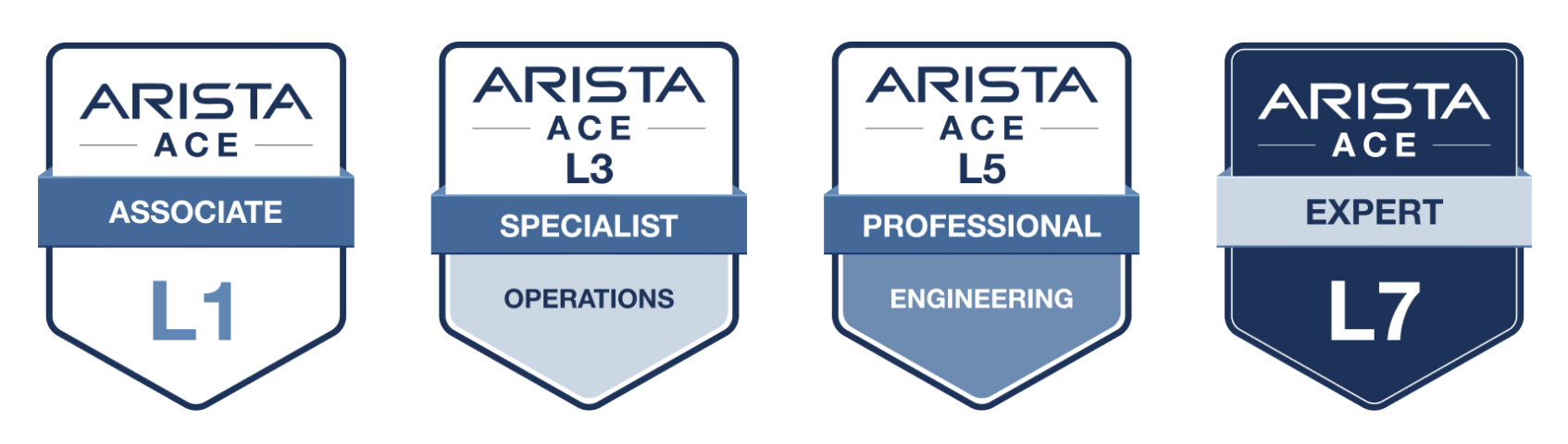
Arista has revamped their certifications! The new Arista Certified Engineer (ACE) program is now organized by specific tracks like Cloud Data Center, Campus, and Automation to better align with your job role.
Feel Free to Reach Out To Us For Your Network Needs

We thank you for taking the time to read out newsletter today. Feel free to reach out to your SE or ASE for more information or questions regardsing your network operations. Until next month, have a good one!